The persistency of the genius

A few days ago Huawei presented their human edited artificially intelligence supported collection. Since then I have run into many conversations and debates on the topic, although after I intervened in one dominated by professionals and experts of that sector, I realized my view was considered too cynical, or that of a technology enthusiast and I stopped engaging further in other conversations. I haven’t had much luck in terms of variety, possibly, but the tone of the discussions I got to be involved in were permeated by fear. Ancient, atavic fear. Fear of losing jobs, fear of the machine in terms similar to those of the XIX century Luddist protesters, fear of being forced to learn and use tools and to acquire knowledge people did not want to or did not feel comfortable with…The background tone of this was that creativity and the unique genius behind it were going to disappear and be forgotten.
This brought me to a couple of considerations on things I tend to ignore

  1. The artistic field might have rephrased the obsolete notion of genius in the “arts” and its position in many areas (hi Benjamin, hi Bourdieu, hi any artist with her team, popping to my mind quickly are Tomás Saraceno or Olafur Eliasson because of their job-ads I often saw while living in Berlin and the people I knew raising spiders for Saraceno). This change though has not yet involved the mainstream notion of the expensive luxury world of fashion industry, (an oxymoron in itself, if the genius was connected to a unique sense of taste without even a social genesis), and this in spite of the fact that fashion houses have huge teams of designers designing, doing trend research etc. It is widely accepted for figurative artists to work with teams nowadays, having a skilled équipe of scientists, artisans, technicians producing part of the final product (something implemented in painting ever since anyway? considering late middle age as a good start, or sculpture in ancient European times), yet the idea of the genius dramatically persists in a way I would have no longer thought possible. Huawei did not do anything special but use a lovely and big database to produce an output. If you had the chance of working with technology this is the basis of everything. Like really. And there is nothing bad, except again in my view maybe the changes to the work flow of people.
  2. The claim that this is an INSULT to creativity and the premises of the death of “CREATIVITY” sound a bit ridiculous and pompous to me because in my, maybe radical view (?), creativity is long dead, intended in this very outdated romantic acception of a solitary work performed by exceptional minds. Having worked for years in translation and content creation without being a translator I have never been scared of the application of AI and MT to this field. It is my daily life and it is not a scandal anymore: I believe instead, it will give translators (or editors already?) even more authority than before in terms of adding a special touch to their content: that one will be the real localisation. I have checked the English version of the blog of two persons I really like and whose work I follow (www.lernen-wie-maschinen.ai/) and realized that their translations contain mistakes, since they are done with an MT that does not get -still- anacoluthon, subjects omissions and this sort of rhetoric expedients. I loved this. Why should it be an insult for fashion? How can this be seen as an insult instead of the complete opposite?
  3. The value of authenticity: Again, the opposition between the genius and the standard relies on the assumpted value of authenticity which cannot be attributed to an artificially (even though “edited” by human) product. My personal leit-motiv apparently, authenticity, identity, invention, tradition, emotions, memory. A personal greeting to Halbwachs, Benjamin, Laurajane Smith and everyone involved in this conversation 🙂 that I am not able to leave, apparently.

(In case, here Another reading on the topic from the Guardian)

Above: carnations filtering Southern light against the wall.
Thy lady of authenticity

The Paris cathedral of Notre-Dame burned partially about a month ago. Drama, tears, money, resentment etc. Everyone spoke about it or felt compelled to express sentiments about it or issued a statement.

The two most interesting readings on the topic according to my interests have been the one by Paul B. Preciado, as it enlightens some relevant aspects of how distorted can the proposed re-building be, and the philantropic US perspective I read on the New York Times, because my focus was somewhere else and it is always important to rememeber where the general focus is ($$$$$$$) or how completely divergent the perspective on the non-profit sector is from a distant point of view, that of a country with substantially different cultural politics & social welfare state.

What called my attention at first was how mesmerizing it was for everyone in Paris: I myself could not stop looking for pictures of people staring at the flames and comparing them to medieval European paintings of suffering saints. I went to sleep over-excited thinking that it was the first time I had consciously assisted to the disappearing of a European landmark, I woke up to check if it had burned out entirely over night and a few days later a friend even wrote me she had dreamt of us living in a roof house on top of it. It was all very present.

A couple of days after this happened, a personal trip brought me to a yet unknown to me part of uninhabited Spain, the super beautiful and incredibly green montanous area between Castilla La Mancha, Aragón, Valencian community and Catalonia. We spoke about Notre-Dame while driving around, and the opinion of my family was “thankfully they are going to rebuild it”.

We visited, I believe, all the tiny and rare villages that the agricultural structure of the past centuries left on our route: we drove for kilometers through the countryside without seeing even a single abandoned house (the opposite of the central Italian landscape, where the division of lands created a pattern of little properties, and the human footprint is strong and evident everywhere. I am so not used to visually face empty spaces). I was with my parents, born in 1940 and 1954. They diligently trust tourist guides, and my father loves to be seen around with a book with the name of region he is visiting in his hands, trusting this will bring him in conversation with local people who will tell him stories, while at the same time being identified as a curious person discovering a new territory. Those 40 years between us are a personal endless source of inspiration, clearly. Anyway, many villages were marked as relevant in their guide, maybe empty, abandoned but with a historical center, or a castle and a monastery etc. As said, we stopped in ALL of them, and many were included in the route of the “nicest villages of Spain“. While I was rather interested in how wild and GREEN the nature around us was, my parents’ focus was on the monuments. Some they found interesting, peculiar, etc. but most they did not like because they were rebuilt. They lacked authenticity.

I asked them why Notre-Dame should be rebuilt instead, and in spite of this it would not lose its identity nor its symbolic meaning and consequent value but instead increase it, while these places could not experience similar paths or afford the same potential. They thought it over and honestly had no rational answer. Instead, facing the evidence that one was socially and politically constructed and artificially made more important, they, who are not so blind not to see that it was a contradiction, could not dare to acknowledge the logics behind it or structuring any thought on the power of emotions and materials.
Having situated authenticity as a cultural construct, it is as if layers of authenticity can be simply wrapped around any object irrespective of its unique history and materiality. The argument that ‘visitors to archaeological sites or museums experience authenticity and aura in front of originals to exactly the same degree as they do in front of very good reproductions or copies – as long as they do not know them to be reproductions or copies’ (Holtorf 2005: 118) exemplifies the cultural constructivist stance. It is undoubtedly the case that replicas can acquire authentic qualities (Hall 2006; Holtorf and Schadla-Hall 1999; Holtorf 2005; Pye 2001), but the important question is how and why some become more powerful loci of authenticity than others. Furthermore, to what extent is their authenticity a product of their physical state and material substance? Sian Jones, “Negotiating Authentic Objects and Authentic Selves: Beyond the Deconstruction of Authenticity “

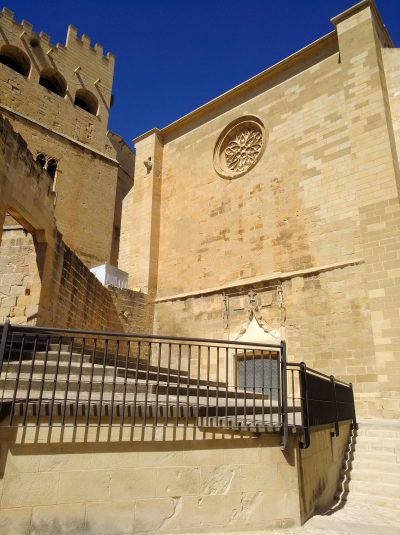
Picture: Valderrobres, Aragon, deepest Spain. April 2019

Connected audience – emotions, the bitter parts

I had been studying the link between museums, empathy and emotions from a sociological perspective for the past 6 months when last January I received the NEMO Newsletter advertising the conference Connected Audience – Emotions in Berlin in April 2019. Perfect timing, sort of closing a circle of months long reflections. Now that I am back from the conference, I have a few thoughts on my mind regarding the event and some valuable inputs to process. Since I learned it to be better, I will start with the bad things and then go on with the positive fact so the latter stick to memory for longer time.

The most relevant aspect for me, as a researcher from Spain, was the complete absence of non North-American & European (mostly western) perspectives. No more than 10 attendees out of over 300 came from Southern Europe and only one speaker came from Russia, which is possibly not yet Europe entirely.

Indeed museum studies are absolutely not something in Italy, for example. But they are in Spain and there was only one other colleague from Spain and one from Portugal. Very sad. Reasons for that? Costs? Language? That might even be true for participants but not for speakers*. Where were they? A conference about emotions in museum which does not include experiences of conflictive events and XXI historical narratives? That was by far the biggest disappointment: in the whole conference there was only a person coming from India and one from Hong Kong. How can a discussion about audience and emotions lack inclusiveness and diversity at its core?

Beside that I acknowledge that overall and everywhere my perspective is annoyingly academic, and therefore focusses always on aspects of work and planning. In general, I focus on data and methodologies (or lack of) of projects, and every time I remain surprised by how knowledgeable some professionals are but how all of a sudden money, grants and big projects take over and nobody in the end cares about the original projects and objectives or will ever state it transparently.

Here two points:

  • Paying people for their work: When asked about the budget the National Museum of Archeology of Naples he had worked with for this project after his presentation, an Italian professor and consultant answered that some things can be achieved if you have very committed people, regardless of how much they are paid, and sometimes they do it even without a budget because they believe in the work they do and that is more important. I hoped someone would laugh out loud, as many attendees had had the rudeness to do when a Russian colleague presented the experience of the Yeltsin museum because it was Russian propaganda (heard in the crowd), but no, nobody said a word. It felt shameless to me, and I felt bad for not pointing this out as I felt outnumbered. It seemed this privileged White group was reinforcing itself in its assumption of art for art’s sake concept, in other words that it is correct to finding compromises such as using students as they might do this for free.
  • The lack of boldness and the gap between the budget some institutions have and the way they openly declare “we haven’t done any front-end research and we do not know who we will work for”. Assisting to the presentation of part of the team of the never ending Humboldt Forum project was really the most surprising thing of all. A controversial project that will give material to hundreads of PhD dissertations on politcs and identity in the coming centuries (if the format of PhD won’t estinguish sooner, as will humanity for that matter), in which over 15 Millions of euros have been invested and about 60 Millions per year are foreseen as budget (here sources: use DeepL / learn German), the Humbold Forum presented a super PowerPoint in which part of its permanent exhibition dedicated to Berlin is described as a fun and entertaining technological space with technologies that might get obsolete in a couple of years and with the complete exclusion of one part of the potential visitors – older ones. What I missed in the Humboldt Forum presentation of Paul Spies and Brinda Sommer was the boldness of saying after we did not do any research” (which I refuse to believe to be true) because this Berlin does not care for the older ones, we want to attract young adults, targeting 16-40 white visitors and therefore we will not provide them with objects (I think 100 exhibits in 4000 square meters were the figures) but with an immersive space that can I interact with, if they want. Everyone else can go to the other museums of the museums island that are across the street around Lustgarten. They wanted to compromise with the conference audience, who was mostly composed by educators and mediators and supporters of inclusion (despite not being diverse at all s.above) but this brought to a broken narrative that would not satisfy anyone and attracted many critics and questions from the public.

These aspects left me with a bitter note of disappointment about the environment I was in, but I will expand on the positive parts soon, because of course there have been too.

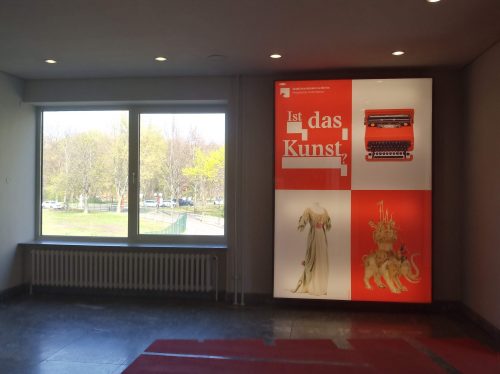
Picture: Tiergarten from inside the Kulturforum and “Ist das Kunst?”, the museums mock the famous pop saying (especially in Berlin) “is this art or can I throw it?” to put itself back on the map using material cultural studies.

*In fact, a German speaker read through her written English text with no intonation in her voice and interrupted her sentences in the middle with no sense of grammar because she had too little confidence in English (something the moderator said, and all questions to her and her own answers were actually translated to German) and therefore made our following of her speech veery challenging. This makes me think also that the organization could have thought of interpreters.

The charm of identity display

A couple of weeks ago I escaped Valencia while the city was being taken over by the local celebrations of Fallas.

While living in Spain about ten years ago, I thought very little of Fallas. Literally. I did not give too much thought to them and I only considered it a loud event to which bright Erasmus students would go to get drunk before going back home to become lobbysts or political VIPs in different countries handling the most crucial matters of our age. No need to get on any bus or train to see it. What I completely misunderstood and never bothered to even try to grasp or feel or understand was the massive support they enjoyed and how deeply rooted that was.

Then 2018 arrived and Fallas came along. I did not know the celebrations would last for weeks and they would overturn the daily life of the city. Little food trucks (the real ones) frying churros, buñuelos and any sort of edible thing from 8 am til 2 am at every corner, all sort of firecrackers at every hour of the day and the night, hoards of people ignoring basic traffic rules, let alone hygiene ones.

And the Parade for the “Flower Ofrenda“: every Fallero and Fallera of the city parades and brings flowers to a statue of the Virgin Mary on the main square. I remember coming back home from work with my bike and facing thousands of people of all ages dressed in expensive and uncomfortable traditional clothes parading through the center, and just stood there speechless. It might have been the first time I experienced a nationalistic folkloric event of these proportions. As an Italian raised in a very laic environment, I am really unprepared for this sort of events, and, I realize, I lack tools of understanding, and empathizing, I think.

With this on my mind, I went away for the weekend, and hopped on a train to the capital to visit friends. Friends have friends, and the latter ones might turn out to be curious and nice persons and all of a sudden it’s 4 am and you are talking nationalistic sentiments in Spain before the elections. It turned out the Fallas had a certain allure to them, actually quite a lot. The festivity as a shared moment through which people connect prevailed over any other nationalistic aspects, in their minds. Even though they had not lived in Valencia nor had they ever been in the city over fallas they envied it. They were longing for the common feeling of belonging to a strongly characterised place, longing for the collective identification process embodied by the attires, the objects, the shared spaces of the city being transformed in its design and traffic, and even in its possible generally accepted normative role.

To me it felt naive, almost childish at times, and it made me acknowledge once again how powerful nationalism as sentiment related to an administratively regulated area is among us, including left wing politically committed adults. It scares me but remains mesmerizing, this building of collective feelings.

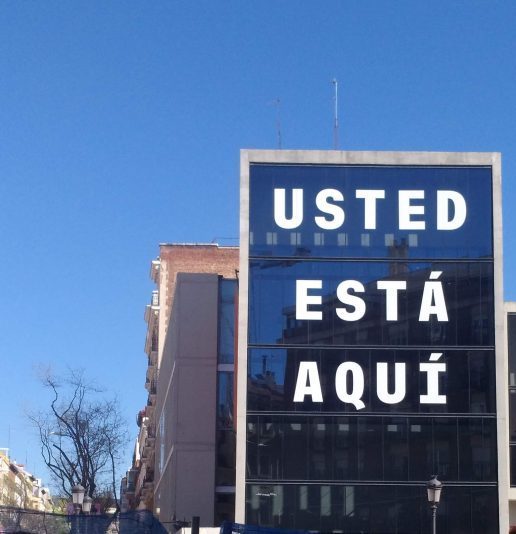
Picture: YOU ARE HERE, Madrid, Centro drámatico nacional, March 2019

On building memories and personal legacies vol. III: the things, the feelings

Some more thoughts on a heritage site in my hometown, a sculpture that has been about to be removed entirely in November 2018 to make space for a parking lot.

Time is a deeply relevant factor in the shaping of feelings, emotions and attachments. Affecting the development of spaces and natures, it spreads around and involves people and their memory. It marks materials and objects to the point that they can be transformed, embody and afford the most different perspectives.

Every cultural objects has a brute materiality and a social materiality, and hard to believe, little we have cared for materials as such and not as a mean or symbols nor as part of analysis of material cultures until just recently.

The Monument for the resistance in my hometown was literally forged in the 60s by the workers of the city harbour, men close in time and space to World war II, the memory of which the monument intended to commemorate. That physical space, though, had grown over time into a neglected area outside of any pedestrian route in the middle of traffic. In the dispute about the position of the monument that took place in November, different levels of attachment to ideas and materials were traceable.
By attributing an emotional and civic value to the site, a specific sensibility shaped around an historical context became defined: one in which public space serves a purpose, and that implies that emotional attachment is strictly linked to a collective and agreed memory. The sensibility of those close in time to World war II, or with a direct connection to it, either by family or studies – social links.
This opposed to two different positions:

  • one was of general indifference toward the topic altogether, as heritage is not part of any discourse for some citizens, and the knowledge about facts happened in the city does not go beyond the last 20 years;
  • a second one was of support for the proposal of moving the monument and create a different way of remembering the events. This was well spreaded among younger people (25-45) for what I could perceive, and I could personally see how the topic was considered not relevant inside the self estimeed cultural élite of the city (doctors, laywers, university professors and so forth) of a supposed left. Because, who is nowadays attached to a form of celebration that implies occupying public space with the representation of an idea embodied in a huge sculture? How can a piece of iron embody any deep meaning? Regardless of the idea, a growing sense of private celebration and private memory is far more important. The simplified narrative of old-static-visible Vs new-invisible-fast I think was behind this, and therefore a general neglect for the real matter was carried on.

Interestingly, in the city almost all roundabouts cointain work of arts by local artists, sponsored not by the city hall but private companies. There is a complete separation between what is considered to be a decorative value (not even functional) of an object and the possible additional meanings it might have.

It is difficult to create an attachment out of nowhere, to make sure that a material embodies ideas that are understood, since that specific material inspires not much beyond rejection instead. This was curiously commented by a person in the “defendors” group, saying she never really felt at ease there and was looking for ways of making it understandable, transmissible. (lot of literature on this topic 🙂 )

In an attempt to build said connection and recreate a sense of community, the group of people defending it started to organize some initatiatives around it.

  • A professor from the Academy of Fine Arts in Urbino (the nearest high education institution for art education) brought his students to the monument and gave a class on the artist, the work and its context.
  • The group installed a Christmas tree in the space, and invited via Facebook the citizens to decorate it with balls with their own names or poems or thoughts about the topic. I do not know how popular or felt this action was, but the tree had quite a lot of balls.
  • Additionally, via two local associations (one working with refugees, the second one the local committee of the national partisans association) some representatives of the group met immigrants and refugees from Gambia, Pakistan, Nigeria and Somalia in the sort-of-square the monument creates and explained the history behind the work of art and what it represented. Interestingly (or obviously) some of them were familoar about Italian recent fascist colonial history and had an idea of what the resistance the monument celebrated was.

Local elections will take place this spring in Pesaro: the mayor will run again and local politicians required already to put the removal of the monument into his program.

I am very curious to see if by then the group will have grown big and strong enough to assign a new position to the site within the city landscape or not.
One additional paradoxal aspect of the story is that Pesaro has long tradition of sculture and claims(ed?) to be a city fancing art: Giò e Arnaldo Pomodoro, Eliseo Mattiacci crossed the city when young, there is a huge community of illustrators gravitanting around it and that is basically omnipresent in the city initiatives (Emanuela Orciari, Alessandro Baronciani, Mara Cerri, Simona Mulazzani just to name a few) but the link between that heritage and its historical contexts fails to be represented.

Picture: Pesaro, potential art piece, September 2017